
Growth gets expensive fast when founders scale without a clear financial roadmap.
Insights
- Forecasting shapes operational discipline because founders who track projected revenue against actual performance can spot margin pressure and cash gaps earlier.
- Top-down forecasting creates market context by helping entrepreneurs estimate realistic growth potential based on industry demand and competitive positioning.
- Forecasting improves accuracy because projections built from pricing, conversion rates, and customer activity connect directly to operational performance.
- Cash flow forecasting protects flexibility since many growing businesses fail from liquidity problems even when revenue appears strong.
Financial forecasting rarely gets treated as a creative exercise, but it sits behind nearly every durable growth decision a company makes. Hiring plans, inventory purchases, expansion timelines, marketing budgets, and fundraising conversations all depend on a founder’s ability to estimate future performance with reasonable accuracy.
Early-stage businesses often operate with limited historical data, which makes forecasting feel uncertain, yet disciplined projections remain one of the clearest indicators of operational maturity. Investors, lenders, and leadership teams increasingly expect entrepreneurs to understand not only where revenue may come from, but also how fast expenses could scale alongside growth.
A 2024 survey from JPMorgan Chase found that cash flow concerns remained one of the leading financial stress points for small businesses in the United States, particularly among companies navigating inflation, rising labor costs, and uneven consumer demand. Forecasting does not eliminate uncertainty, but it gives entrepreneurs a framework for managing risk before problems become expensive.
Top-Down Forecasting Creates Market Context
Top-down forecasting starts with the broader market before narrowing into the company’s realistic share of opportunity. Founders often use this method during fundraising, strategic planning, or market-entry analysis because it helps establish the scale of potential demand.
The process typically follows three layers:
- Estimate the total addressable market available within the industry.
- Narrow the opportunity into serviceable geographic, demographic, or category segments.
- Apply a realistic market-share assumption based on competition, pricing, distribution, and operational capacity.
A SaaS founder entering the project management category, for example, may begin with total software spending within the sector before narrowing projections toward mid-market businesses in a specific region. The final estimate depends on realistic acquisition assumptions rather than idealized market penetration.
Top-down forecasting works best when entrepreneurs need a strategic perspective. It helps leadership teams understand whether growth expectations align with actual market conditions. The method also creates useful context for investors evaluating long-term scalability.
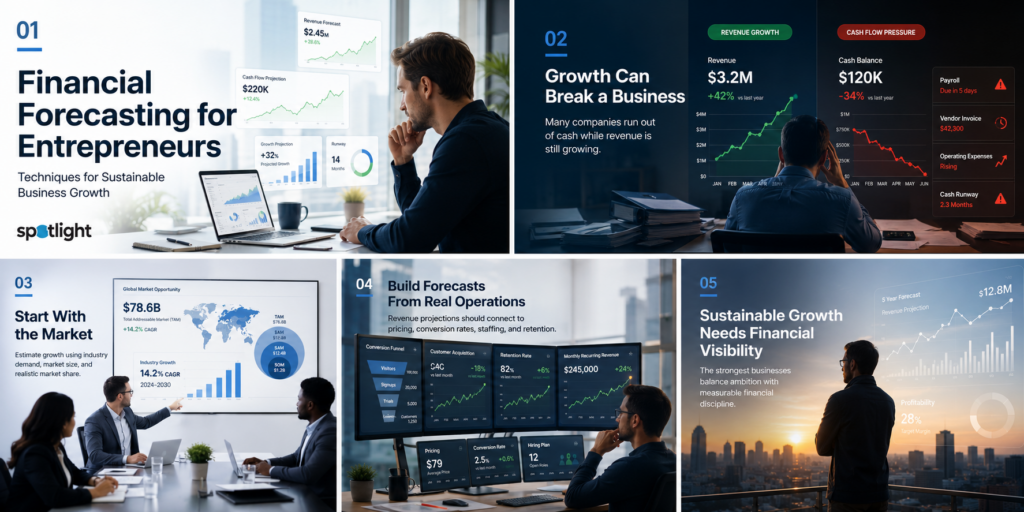
The challenge is precision. Market-level projections can easily drift into optimism if assumptions are disconnected from operational realities. Founders who rely exclusively on top-down models often underestimate customer acquisition costs, sales cycles, or fulfillment limitations. That gap becomes especially visible once businesses move from planning to execution.
Bottom-Up Forecasting Connects Revenue to Operations
Bottom-up forecasting approaches the problem from the opposite direction. Instead of starting with industry size, entrepreneurs build projections using internal business mechanics such as pricing, sales volume, conversion rates, retention, and production capacity.
This method generally produces more grounded forecasts because every projection ties directly to measurable activity.
A bottom-up revenue model may include:
- Monthly lead volume
- Website conversion rates
- Average order value
- Sales close rates
- Subscription retention
- Production output capacity
- Staffing limitations
An e-commerce company forecasting quarterly revenue, for instance, may calculate projected traffic growth, expected conversion rates, average cart value, and repeat-purchase behavior. A consulting firm may estimate revenue based on billable hours, average client retainers, and utilization rates.
The strength of bottom-up forecasting is accountability. Each assumption can be tracked against actual business performance, making it easier to refine projections over time. Entrepreneurs also gain better visibility into the operational drivers influencing revenue growth.
Research from McKinsey & Company has shown that companies using data-informed planning frameworks often make faster strategic adjustments during volatile market conditions. Operational forecasting supports that flexibility because weak performance signals appear earlier inside the model.
Cash Flow Forecasting Protects Business Stability
Revenue forecasting receives most of the attention, yet cash flow forecasting often determines whether a growing business remains stable during expansion. Many companies generate strong sales while still struggling with payroll timing, inventory costs, delayed receivables, or rising operating expenses.
Cash flow forecasting focuses on timing rather than total revenue.
Entrepreneurs typically monitor:
- Expected incoming payments
- Recurring operational expenses
- Seasonal fluctuations
- Inventory purchasing schedules
- Tax obligations
- Debt repayments
- Hiring timelines
A retail business preparing for holiday demand may need to purchase inventory months before customer revenue arrives. A B2B services company may close large contracts while still waiting 60 to 90 days for payment collection. Without cash flow planning, both businesses can face liquidity pressure despite healthy sales pipelines.
According to U.S. Bank research frequently cited in small business lending discussions, cash flow mismanagement remains one of the primary reasons businesses fail. Forecasting gives founders a practical mechanism for identifying stress points before liquidity problems disrupt operations.
Rolling cash flow forecasts have become increasingly common among growth-stage companies. Instead of building annual projections once per year, leadership teams update forecasts monthly or quarterly based on actual performance trends. That approach creates faster feedback loops and reduces the risk of relying on outdated assumptions.
Scenario Planning Helps Businesses Prepare for Volatility
One forecast is rarely enough for businesses operating in unpredictable markets. Scenario planning allows entrepreneurs to prepare for multiple outcomes without overcommitting resources.
Most forecasting frameworks include three primary cases:
- Conservative case
- Expected case
- Aggressive growth case
Each scenario adjusts assumptions around sales growth, expenses, hiring, pricing, and customer demand.
A startup preparing for expansion may build one forecast assuming slower fundraising conditions and another assuming accelerated customer acquisition. A restaurant group evaluating a second location may model occupancy fluctuations, labor cost increases, and supply-chain volatility before committing capital.
Scenario planning does not exist to predict the future perfectly. Its value comes from preparation. Companies that evaluate multiple financial paths tend to react faster when conditions shift unexpectedly.
The forecasting process also improves internal communication. Teams gain clearer visibility into hiring timelines, budget constraints, and operational priorities when financial assumptions remain transparent.
Forecasting Habits That Improve Financial Decision-Making
Strong forecasts depend less on complicated spreadsheets and more on consistent operating discipline.
Entrepreneurs often improve forecasting quality when they:
- Review projections against actual results monthly
- Separate fixed and variable expenses clearly
- Avoid optimistic sales assumptions unsupported by data
- Build contingency reserves into cash planning
- Update forecasts continuously rather than annually
- Use historical performance trends where available
Forecasting also becomes more reliable as businesses centralize operational data across sales, marketing, finance, and inventory systems. Fragmented reporting often produces inaccurate assumptions that weaken long-term planning.
Artificial intelligence and automation tools are beginning to influence forecasting workflows as well. Financial software platforms increasingly provide predictive analytics features that help businesses identify trends, seasonality, and expense patterns earlier. Even so, judgment remains central to the process. Entrepreneurs still need to evaluate assumptions against market conditions, customer behavior, and operational realities.
Financial Visibility Supports Sustainable Business Growth
Forecasting is ultimately less about prediction and more about preparedness. Entrepreneurs rarely control market conditions, customer demand shifts, or economic volatility, but they can improve the quality of the decisions surrounding those variables.
Businesses that forecast consistently tend to allocate capital more carefully, respond faster to operational pressure, and communicate more effectively with investors and stakeholders. That discipline becomes increasingly important as companies scale and financial complexity grows.
The strongest forecasting models balance ambition with operational realism. Growth projections may help inspire teams and attract investors, but sustainable businesses are usually built on assumptions that leadership can measure, monitor, and adjust in real time.
Spotlight Creative Agency helps founders and growth-stage brands build sharper business narratives, strategic positioning, and investor-ready messaging that support long-term growth planning.